The Holocaust Through the Eyes of a Maus Art Spiegelman Full Interview Transcript
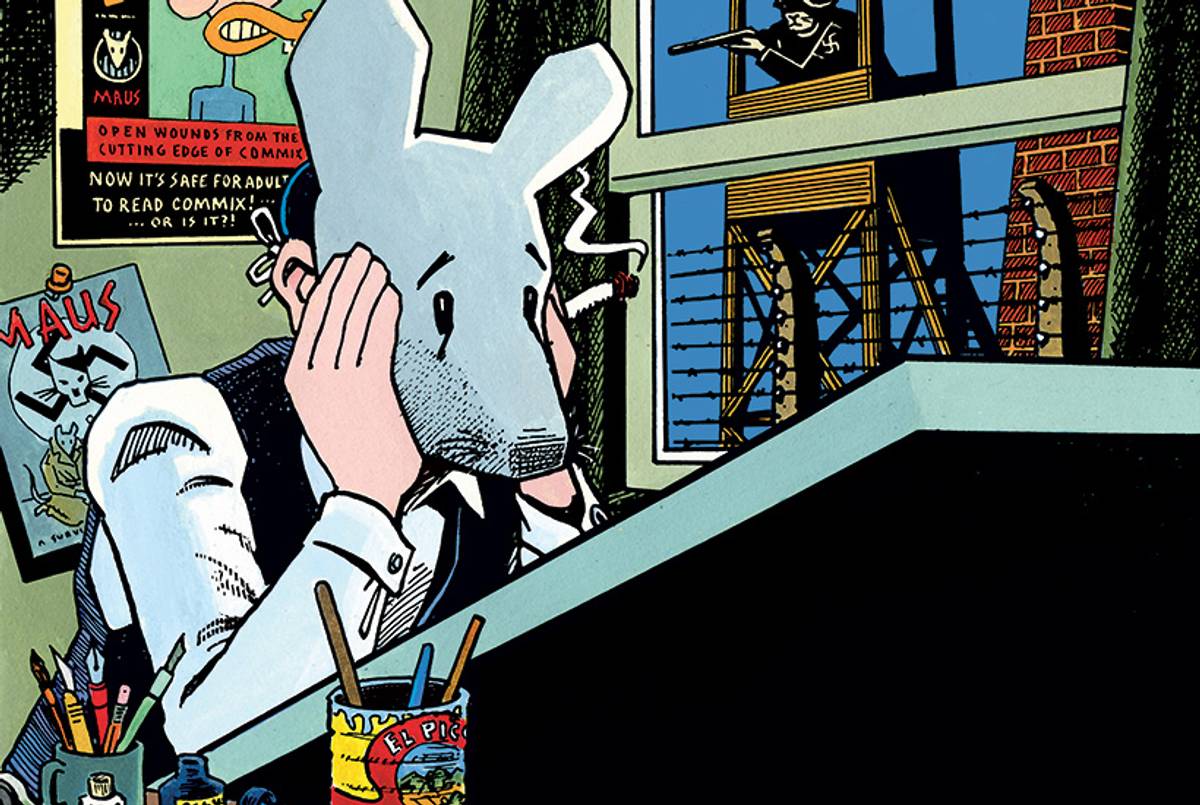
"The Holocaust trumps art every fourth dimension," Art Spiegelman repeated more than one time at the press opening for his traveling mid-career retrospective, which originated in Paris and finally landed at Manhattan's Jewish Museum this month. Spiegelman, whose name can be translated as "art mirrors homo," is the owner of a stunningly fertile graphic imagination that over the past 40 years has produced dozens of formally innovative and often searingly self-cogitating strips in various magazines, including Arcade and RAW, which he co-founded and edited with his wife, French artist and editor Francoise Mouly. In his day job at the Topps trading bill of fare company, he created and edited the Garbage Pail Kid series before moving on to a more upscale twenty-four hours job at The New Yorker, where he tweaked that magazine's DNA with iconic comprehend images, including a Hasid and a black adult female kissing on Valentine's Day in Crown Heights and the famous mail service-Sept. 11 "blackness comprehend," which, when you held it at an bending to the light, showed the outlines of the vanished Twin Towers.
Spiegelman credits Mad mag and the sensibility of its founder Harvey Kurtzman for shaping his childhood in Rego Park, Queens, and his early want to utilize cartoons to express his sense that something was not entirely right with the earth. His outset Mad anthology, which he studied with the intensity that some of his peers brought to pages of the Talmud, was a gift from his mother, who survived Auschwitz, and he was kept on a tight upkeep by his father, who also survived Auschwitz. (Spiegelman was born in Stockholm, Sweden, after the war; his brother Rysio died in Poland earlier he was built-in afterward being poisoned in a bunker along with two other modest children past his aunt, so that they wouldn't be taken to an extermination army camp.) When Spiegelman was 20, his mother killed herself, and Spiegelman was released from a country mental institution in Binghamton, N.Y., to nourish her funeral—an event that would become the ground of one of his early, devastatingly personal cartoons. Spiegelman's father then burned his mother's diaries near her experiences during the war and in the camps, which she had intended for her son to read after her death.
Starting in 1978, Spiegelman, then a well-known underground cartoonist, began interviewing his male parent about his wartime experiences. In the early 1980s, he began creating strips that narrated his father's stories and were gently framed by his own human relationship with his male parent, a miserly and compulsive character; the strips were published in RAW under the championship Maus. Both the title and the device of portraying Jews as mice and Germans as cats had been used by Spiegelman before, in a three-page strip he had published in 1972 and that was later published in his collection Breakdowns: Portrait of the Artist every bit a Young %@&*!, which attracted the deep admiration of hundreds of culling comics fans but few buyers.
Today it seems clear that Maus and Maus Ii are the most powerful and significant works of art produced by whatsoever American Jewish writer or artist about the Holocaust. While their indelible popularity is a tribute to Spiegelman'south incredible honesty and his graphic and narrative talent, information technology is also a reflection of the way in which the Holocaust has morphed from a threatening and largely repressed communal trauma to the mucilage that binds the American Jewish customs together. If Art Spiegelman is a genius who created a piece of work of searing originality and insight out of his familial and personal suffering, it is also difficult not to worry virtually the anti-aesthetic consequences of his achievement. If he is right to complain that the Holocaust trumps fine art, information technology was Maus that opened the floodgates.
***
David Samuels: I was sitting downstairs waiting to talk to you this morn, and I was watching all the people passing by the hand-inked panels from Maus II, which are preserved safely behind glass in the gallery. And I suddenly had this vision of Maus being preserved for posterity like the Expressionless Sea Scrolls in some big weird-shaped climate-controlled building on the Mall in Washington, so that futurity generations of American Jews tin remember the Holocaust, which is what we were apparently put here on earth to do.
Art Spiegelman: OK, thank you for bumming me out. Let's movement on.
Does that bum you out? Why?
I hateful, I've now drawn information technology fifteen dissimilar ways—the giant 500-pound mouse chasing me through a cave, the monument to my father that casts a shadow over my life right at present. I've made something that clearly became a touchstone for people. And the Holocaust trumps art every time.
Well, in that location's that, sure.
I'one thousand proud that I did Maus; I'm glad that I did information technology. I don't really regret it. But the aftershock is that no thing what else I do or even most other cartoonists might do, it'south like, well, there's this other matter that stands in a carve up category and it has some kind of canonical condition. Information technology's what y'all're describing with your Expressionless Sea Scrolls analogy. It's been translated into God knows how many languages, information technology stays in print, it'southward a reference point. Then, when I'm reading some picture show review in the Times about 12 Years a Slave, all of the sudden I'chiliad seeing a reference to Maus, even though the subject area matter is quite different. It's studied in schools from the time they're similar in middle school to the time they're doing post-graduate work.
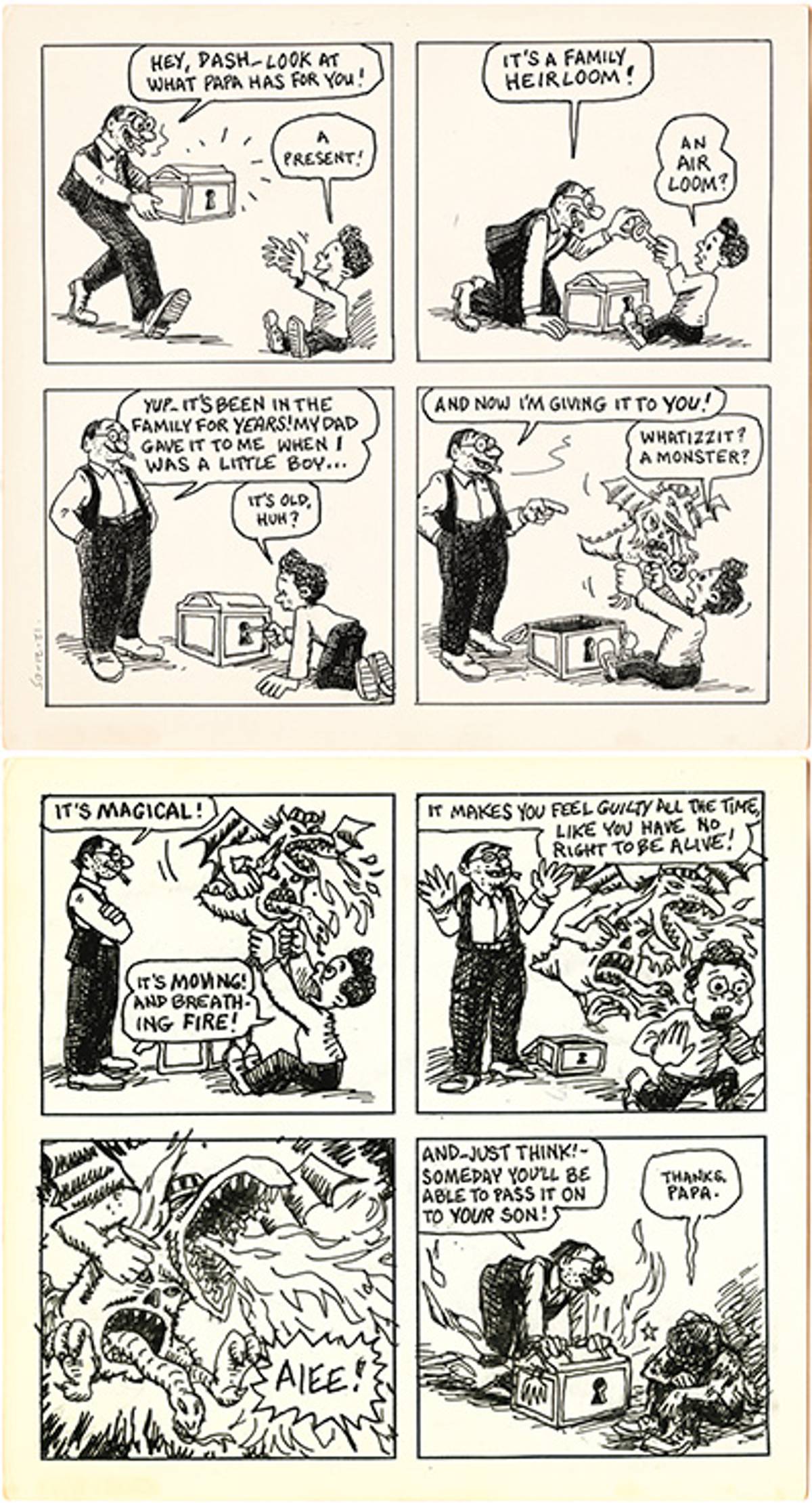
In that location was that slap-up strip that you did for the VQR, where you were handing a little treasure chest to your son Nuance, "Hey, here'south this wonderful magical present"—the gift being historical memory—and he opens the box and this horrible fire-breathing dragon comes out in an Auschwitz striped prisoner's cap with a little extra Hitler caput and breathes burn on him and burns him. And he's similar, "Gee, thanks, Dad."
It's one that you lot can't bargain with and so move on easily. I remember Claude Lanzmann at some point saying Shoah ruined his life.
Except he wanted his life to be ruined in that way.
Yeah, but I don't know if I wanted information technology or didn't want it. Information technology wasn't part of my operating system. I wasn't thinking about it.
Right, and that's what made Maus and so dissimilar and constructive equally art, that feeling of absolute sincerity in an unexpected form. Just if I wanted to really bum you lot out I'd say that some huge role of the genius of postwar, American Jewish fine art took some energy from the repression of that monster that you let out of the box. You lot can read all of Philip Roth for a long time until yous get to The Ghost Writer, you tin read Blare, you can read Joseph Heller, and look in vain for any mention of the Holocaust.
I just watched on Netflix the Salinger moving picture a few days agone, and all of the sudden, Dachau is the codex for Catcher in the Rye.
Right. Except, he never wrote a volume about being a young American soldier in Dachau. He wrote a volume about a preppy kid riding the carousel in Key Park.
Manifestly he married a Nazi, and it'southward the subject of ane of his unpublished manuscripts that'south going to come up out in the next 5 years or something.
So, it turns out that J.D. Salinger was writing his own Glass family version of Maus up in Cornish, N.H., in add-on to eating sunflower seeds, or whatever else he was doing up there.
I don't recollect his drawing is good plenty to exercise it as Maus. What am I going to do? Say I wish I didn't make Maus? That's just not true. And on the other paw, do I want to have information technology dogging my steps everywhere? I'm going to say I'k lucky that information technology does, because it allows me to enter one folly later on another and still make royalties from something else.
But what does information technology mean for me now at this signal? Wait, my cells have replenished themselves several times over, and information technology is what it is, and I did everything I could to tithe to information technology, to give service to it, by making MetaMaus, which is more than easily accessible for most people than having to come up to a room in the Jewish Museum. I guess it all reminds me of Joseph Heller's response to being told no matter what he did afterward, "Well, it'south skillful but information technology'due south no Grab-22," to which he said, "Yes, but what is?"
Just it'south an result considering I'chiliad not dead withal. So, I accept to keep moving every bit all-time I can through the shadow of something that I'one thousand glad I had pass through me.
That's a very svelte, healthy, well-processed answer. And there are two directions that I want to have that. The Pew Foundation just did a big study on American Jewish life, and who American Jews are, and what they think makes them Jewish. And the No. i answer that the respondents gave about what being Jewish means was "remembering the Holocaust."
Now, I loved my gramps, he was the person I felt closest to when I was a child, and he was the only member of his family to survive the war, and I grew up in a customs with lots of survivors. So, the aftershock of those terrible experiences was definitely passed on to me and kids in my generation, even if information technology was outside our full awareness. And I wouldn't wish those furnishings on anybody, you know? Then, information technology's interesting to see the American Jewish community cull "remembering the Holocaust" as the touchstone for its sense of communal purpose. American Jews are people who recall the gas chambers in Auschwitz.
Nosotros are here to acquit on the traditions of the Marx Brothers and Harvey Kurtzman, as far as I'grand concerned.
Inevitably, this specific odd and intense cultural burden of carrying forth the near extinction is too something that Jews have a responsibleness to do. And the problem for me, its most thorny identify, is when nosotros outset thinking about the beingness of Israel. If you lot wanna, since it's Tablet, nosotros can become at that place.
Go ahead.
For me, it's sort of like, "OK, Zionism existed before the Holocaust—just the Holocaust is the broken condom that allowed State of israel to get born."
So, at that point, what are we remembering when we recollect the Holocaust? Are we remembering that Jews specifically accept to exercise whatever is necessary to ensure their ain survival at the expense of others, who share a large part of our common Dna?
That seems like a very pleasant humanistic lesson to pass on to 1's progeny, no?
The thing you can recall is "Nobody e'er liked you, they're not going to similar y'all, and then fuck 'em. And therefore State of israel is going to do whatsoever it has to exercise to survive, by God." Or the other lesson could be, "We got shafted because nosotros were a landless people without a power base and therefore, what? We create another landless people without a power base?"
Fuck. I mean that doesn't seem similar the all-time lesson to learn from the larger cosmos of what Maus grew out of. In the showtime three-page Maus, if you expect at information technology downstairs, there are no references to Jews, and no references to Nazis per se, although clearly information technology underlay the entire project.
'The Holocaust is the broken condom that immune Israel to become born.'
At that bespeak, very specifically, I was dealing with this from a very secularized notion of what it was to be oppressed in a political organisation. That's what it meant to not talk well-nigh Jews and Nazis. It grew out of thinking nearly the blackness state of affairs in America, which is why it'south non totally divorced from 12 Years a Slave. I didn't see that one coming, but I get it. It depends which lessons yous choose to extract and move forward with. One is potentially useful because it increases one's empathy factor, and 1 is unsafe because it increases the ways in which you defend your little corner of the Dna empire from all others.
I think the narrative that "Oh, Israel was born out of the Holocaust and never forget and whatever" was very popular in the U.S. at a certain indicate, particularly in Queens, where you grew up and in Brooklyn, where I grew upward. I get the sense from my family and friends in State of israel, though, that they were completely uninterested in the Holocaust when the state was created, and for a long fourth dimension after that. I think having lunch with the Israeli novelist Aharon Appelfeld, who in my opinion is perhaps the greatest living Jewish writer anywhere, who survived the Holocaust and emigrated to Israel. He told me that when he came to State of israel they called the refugees "savonim"—soap people. The ones who were going to be made into soap by the Nazis. The Holocaust didn't really fit with the proto-Soviet realist aesthetic of sturdy pioneers with muscular asses working the fields, and all that.
Yad Vashem wanted to show Maus. And I was going like, "Oh God; do I have to practise this, I don't want to practice this." Talking virtually your Dead Bounding main Whorl vision, you know.
I imagine it in the Holocaust Museum in D.C., in its ain special wing, you know?
In that location was a point when we were talking about having Maus in the Holocaust Museum, and I was much more interested in seeing something about the quondam Yugoslavia and genocide at present. So, that's the tug of war that I'chiliad talking about.
I don't know how to answer to the prewar sabras and their vision of Zionism. I but don't think that Israel would have come into being without the Holocaust happening in the world, because I don't remember that the Balfour Declaration of 1917 or whatever would have held upwards that well without it. The world wouldn't have cared.
I call back those guys were tough and ideologically driven, and they were ready on their goal of establishing a Jewish country. This summertime, I interviewed Shimon Peres, the current president of Israel, and I asked him, when did yous find out near the Holocaust? And he said, "Well, after the war, you know, when those people came."
At to the lowest degree he didn't wait to read Maus.
I was like, "What was your response?" And he told me, "Well, you know, we went to Poland in 1945," and so he started going into a long discourse well-nigh how Golda Meir was trying to undermine him at the time with David Ben Gurion, or whatever—my emotional translation of that story being that he actually didn't care about the Holocaust, because he was so wrapped up in the political infighting among this hothouse grouping of people who came to Palestine when they were 15 and were building a Jewish socialist-collectivist mecca in their own imaginary version of the Middle East.
I understand all that only, you lot know, it used to be when I was first out and talking well-nigh stuff, I would actually accept horrible arguments when people were talking almost Maus, even when it was yet not published every bit a book yet and when information technology was first published every bit a book in which somehow anything that had to do with State of israel had to be supported absolutely. That'southward changed since 1983-4-v, and now radically. So, at present it's impossible to remember of these things as disconnected. Whether they want to talk nearly it or not, something happened. And what happened was the world's agreeing that, "All right, and then you didn't take whatever place, and we saw how well nationalism worked on the planet, then rather than trying to similar move beyond information technology, permit's give yous a nation! Permit it exist." And from that moment on, certain things started happening. Parenthetically, I'm amused by Chabon'due south actually great Yiddish Policemen's Union book.
The frozen called.
There were a lot of alternate universes in which people are trying to figure out what the hell to practise with the Jews. We'll send them to the tundra, nosotros'll send them to Madagascar, depending on who was deciding on the existent estate for us. And 1 of the possible places was Palestine, which in a way is an absurd identify for it all to exist.
What piddling I found out virtually the secret origins of the superheroes of the Jewish nation is that it was itinerant salesmen back in the Babylonian days who planted their seed and said, "You're in accuse of giving these kids organized religion, and it's Jewish. OK? Gotcha, I gotta go somewhere else now, I'm an itinerant." And this gives y'all a charter? Probably, I don't know, but that seems pretty sketchy to me.
Then, what at that place is now is at that place's this inevitable thing that came with the trauma of WWII for the earth'southward Jews, conspicuously. That led to something kind of interesting, which is—I can't quite say it. I tried to say it when Tony Kushner was putting together a book about American liberal responses to the Jews. He asked if I would exercise the encompass because I was doing a lot of these New Yorker controversial covers, helping that become function of the Deoxyribonucleic acid of what The New Yorker now is. Merely at that time I said, "Look, I don't want to do a picture inside the book, man." It'due south great, but I'chiliad so tired of having to submit work and run across if it would pass for people and so having to submit work and see if information technology will pass, and and then having to defend the work. So I said, "I can only take this on if you lot'll give me a blank check. I'll practise information technology, you lot'll run it. But y'all have to know that up forepart."
And he said, "Uh, I'll have to check with"—I don't remember who the publisher was—"and see if that's OK." I said, "Fine." Then he said yes, and so I came upwards with an thought I actually liked and and then I thought, "He's a really fine boyfriend, that Tony. I really adore him. I like him. I don't desire to requite him whatsoever grief." I got but as far as getting the idea and making the very first sketch that had some photo-collage elements and any. I said "Tony, I know we've got a deal, but I've decided I'1000 non going to concord you to it. So, hither's the sketch, tell me if you want it. It'south going to be a hurting in the donkey to paint, information technology'll accept me a couple of weeks, if yous want it it'due south yours."
It was a close-up based on the aforementioned famous Life magazine photo that was at the starting time of the three-page Maus: Palestinians behind barbed wire wearing Jewish stars. In forepart of the barbed wire was an Israeli soldier with his gun and too with a Jewish star, and he'due south as well backside the barbed wire and looking mournful besides. And the implications of it are unbearable for a lot of people, it makes their heads explode. Nevertheless.
That image was all I could say. Because information technology was fortunate plenty for my parents went to the correct rather than to the left in that line, and they ended upward hither, and so I don't take to bear the burdens direct of Israel's culture. Then, that image just has to do with the fact that information technology's victims victimizing each other, damn it. Here we go again. And there'southward a responsibility that State of israel doesn't alive up to, and information technology drives me crazy.
I hear you. But I'g a kickoff-generation American who was born in Brooklyn. And then, while there'south something interesting about these American Jewish narratives about Israel existence all skilful, or else bearing some special moral responsibility for extra-good behave that it spectacularly fails to meet, both those narratives seem a bit weird to me. There'southward i grouping of people who has a cartoonish vision of Israel every bit some beleaguered innocent state. And and so there'south another group of people who seem to say, "Well, of course, if it'south going to exist a Jewish state, my demand is that it should always be perfect, or otherwise information technology shouldn't exist at all." My personal feeling is that Jews, in some deep mode, aren't inherently any different than Armenians or Serbs or any other of these tribes with long histories, all of which involvement me aesthetically and historically. But I personally don't see State of israel as any more intrinsically good or bad than France.
Or America. Merely Israel'southward history went on for a very curt fourth dimension, which is the flip side of the same reply. Information technology was born when I was, and it thereby is more straight discomfiting than when I drive around Monument Valley and come across what'southward left of the Indians, even though that'due south pretty horrible. I somehow become, "Me, I'm a stranger here myself. I didn't do this, it's terrible, I concord it'due south terrible."
But that's slightly viscerally different to me than when somebody snarls at me because I'm Jewish, even though I oasis't a religious bone in my body. And yeah, at that signal the cultural heritage of what brought me here comes into play. And that makes me more able to tap my ain guilt than even when I become to encounter 12 Years a Slave and get to feel guilty most what I did in the slave trade.
The historical 'I' that is a white male Southerner, circa 1850.
Right, but hither I am equally a white male person in 2013 living with the fruits of that exploitation, every bit well equally the guilt and horrors that come with that 19th-century slave trade. And I don't know what to do nearly any of it. I was born a Jew in Sweden.
All I tin say is I'm really glad I'g a diaspora Jew. I don't identify with Israel. I've almost gone several times every bit an adult—never, always bailed at the last minute. If I go I'm going to mouth off, then I'll get myself involved in some project I don't want.
There's a thriving Israeli left, they spend their time mouthing off, and they get a lot of coin from foundations for doing it. I guess my personal posture on these large issues is "Hey, I grew upwardly in a housing projection in Brooklyn, I didn't oppress black people in the Due south, I didn't kill any Palestinians in Israel, so I'm happy to talk to anybody, as long as they are being cool with me." And if they're not, my interest wanes.
Yeah, it'south but it's inevitably part of anything that comes out of that Maus book that I stop upwards having to at least think it through, because of what you were saying to start this particular gambit. And that has to do with the fact that the master matter that defines one's Jewishness unfortunately is non Groucho Marx. It's the Holocaust.
I remember when RAW offset appeared, I was in high school in New York. And it was but one of those touchstones of cool if you had a new copy. That's like the fashion loftier-school kids used to read that stuff, information technology'south only like it's sacred. And it was great. I remember the fact that someone had turned the Holocaust into a drawing strip, and that the Jews were mice and the Germans were cats, I remember thinking, how did he even get on tiptop of all that shit, which none of u.s. could begin to imagine except in the ways that it was given to the states, as something that was too big to imagine in anything but the accepted ways. Information technology was just like, "Was the person who did this evil thing, is he a genius?" It was the total coherence of that gesture, similar Cubism—
That'south interesting, ha.
And the emotion in it, and the drawing, and all of it. Growing up in a Jewish customs here, it felt similar the ultimate Samizdat. Nosotros didn't fifty-fifty know, like practise we bring this to our teachers and enquire them if it'southward good or bad, because what if they punished u.s.a., or, even worse, what if they liked it?
Now we notice out, they seem to like it. I know we're talking nigh simply the center part of the showroom that I'm grateful to take it, because it has the 2 other parts. Merely we're talking almost the center part.
And this is your life now that you created Maus, and yous have to sit in well-appointed conference rooms with people similar me and go over and over that.
But you know you're the first interview where this was truthful. Because you're Jewish. They might be Jewish likewise, but they at to the lowest degree came from a different fix of perspectives where I am not trapped again in this same conversation.
So, maybe it is me. But I was going in a completely different direction at present, which is depressing in a different fashion. I recall that function of the power of your original gesture was that in that location was nevertheless this feeling of resistance in the civilisation. In that location was something that y'all could push confronting. The thing that I feel now is that spirit has been diced and tamed and put through some kind of food processor. I don't notice the places where the culture blob doesn't engulf whatever it is in three minutes flat.
'The Simpsons,' 'The Daily Bear witness,' 'Colbert' are among the healthiest aspects of American culture right at present
This can actually bring me back to my Groucho Marx moment here, or pin, which has to exercise with the Groucho Marx and Milt Gross and Harvey Kurtzman legacy, which was an incredibly important i. Now, if you're talking about nationalism, and then you take to get to Duck Soup within a couple of seconds. And that impulse predates WWII, and it'south an outsider's perspective on a culture, and in that location are however plenty of outsiders to this culture, and things will come from that yet, I believe. That's ane point.
The other betoken, which is more to the signal perhaps, is the impulse—I see it through Mad, considering it's the one that'south imprinted on me. Mad fabricated the resistance to the Vietnam War even possible. And that seems really, deeply truthful, not merely some kind of wise-crack true. Because the '50s felt incredibly monolithic. The early '50s was an incredibly oppressive place in America, very iconically represented by a decent-enough liberal chap named Norman Rockwell. Information technology's when we got this 'In God We Trust' on our money, it's when we had our crazy McCarthy moments, nosotros had all of these things happening, and yet there was room for a very effective antibody, which was this kind of self-reflexive, cocky-deprecating, angry response to the homogeneity from people who weren't thoroughly homogenized in our civilization, i.east., Jews. It led to something very fruitful, and nosotros however have the backwash of it, both positively and negatively.
Positively for me, I would say, The Simpsons, The Daily Show, Colbert are among the healthiest aspects of American culture right now. And they take to do with carrying the genuine legacies of the earliest Mads forwards.
There's another thing that happened as a result of any antibody condign weaker afterward a period of fourth dimension like at present that all our cows take antibiotics in them nosotros're not as good at fending off all of the diseases. Similarly, the Mad impulse of irony has been reduced to the air quote, and the cocky-reflexivity is everywhere in the culture. It starts in the spin room, and spins on out. And the spin room is about spinning united states of america as viewers of news, it'south not well-nigh deconstructing news, it'south about enforcing the takeaway messages, right?
So, I felt that like, now we needed something else, and for a while I was just calling and at present I've dropped information technology, it was a particular thing I think nearly a lot. But I was thinking, we needed this affair that I was calling "neo-sincerity," which was involved with specifically using the tools that Mad offered but just in the pursuit of absolute conviction. And that that was the just mode to get back to a place where you could tell where people were coming from and figure out what actually has value and is of import and can't be reduced to the ironic Letterman shrug.
Yeah, a lot of writers my age came to that conclusion too. Dave Eggers was certainly ane. And lots of smart people tried information technology, but information technology was like, you know in a way, all those nice liberal people from the '60s have go the Eisenhower Americans of today, except they vote for Democrats. They're the baby-boomer grownups of your generation, and in some ways they are more dangerous. Considering they always have just enough sympathy with whatsoever the gesture is, and they smoked pot likewise, and they dropped acid back in the 24-hour interval, and they go, "Aye, yeah, yeah nosotros like that and we'll appropriate some of it, but and so please don't exercise this other matter that y'all just did, because information technology's only too transgressive and messy and gross." And information technology'south similar, they've already allow y'all in the door and are paying your rent, and then please don't exercise that yucky cover you wanted to practice.
In that location's that. Only there'south likewise the fact that even if you become to do the yucky embrace, it'due south similar what was the really dandy metaphor from a Kafka story about leopards? The priests have a ritual, then one twenty-four hour period the leopards prove up and consume all the priests, and and so they resume the ritual the year after, including all the leopards. It's an amazingly resilient and resistant culture, capitalism. And we're the beneficiaries of information technology, then nosotros're not almost to go to the barricades and set burn to our own houses. But and then what?
If Jews carried that oppositional torch for a while for item historical reasons in 20th-century America, the truth is that Jews are merely another group of rich white people now. They're not outsiders, but they go on believing that they are still outsiders, raging against the machine as part of their secular faith of being proficient empathetic liberals. And at a certain point, information technology becomes empty-headed.
Information technology's a condition of outsiderness that we can build on. That's all we've got. Considering the alternative is to become a Madoff or something, I don't know.
I think the culling is to own upwards to being WASPs.
Oh, WASPs don't get to mutter, so I don't call back I want to go in that location.
Maybe Jews can be the new complain-y kind of WASPs.
Possibly the new complain-y WASPs.
I think that there's something that gets eroded, which is, you know, that outsider thing obviously doesn't happen equally hands once you're inside. It gives me reason to pause and worry almost what it is that keeps driving me. And because I don't run across where anyone can actually find a place to pry at, that pries it all open.
I could say that, in that location was a infinitesimal in that location where Occupy Wall Street was the simply positive thing I saw in the culture. And it was astonishing how easy it was to sentry it evaporate and get pushed to the sidelines with the first rainstorm. Nosotros have it in the corner of our ears because of one slogan that survived, that moment which has to do with the 1 percentage, but information technology was a useful moment to enter in, despite everything that didn't happen. And as picayune as that is, it's yet a footstep in the right management, to find who has got the cards.
On the field of study of cards, maybe the moment is right for you lot to get dorsum to the Garbage Pail Kids.
They're still being washed.
I experience there's a re-imagining of that imagery for the era of Facebook and Twitter, which are the new untouchable toxic brands.
I'one thousand sure that volition be washed, and it sort of exists without it existence homogenized. In that location are artists who are working off of that free energy because they were at the correct historic period when that matter happened. Were you? You were a Garbage Pail Child fan?
I used to buy them sometimes for my younger blood brother. He really loved them.
A lot of people are imprinted with them, and it fabricated a difference. I thought of it very consciously as taking my Mad lessons and passing them along dutifully to the next generation. And at that place I must say, I made certain that the title cards at to the lowest degree in this prove were articulate about what parts I had to practice with and what parts I didn't take to do with it. I didn't paint those things, I planned them.
It was an intervention, as the French people say. Yeah.
Now it would unfortunately just exist more leopards coming into the ritual. Because that existed, at present what's next; I'grand sure we'll observe out, you know?
Is that a problem for culture? If you look dorsum at the stuff that I was raised on, whether it was little 'zines or information technology was RAW or whatever, that stuff was actually hard to get. Y'all had to get to a specific store somewhere weird to notice information technology. And people had to stew in their festering little pool for a while, until you got drastic enough to visit someone else's puddle and chance them making fun of you and the apparel you lot wore.
I think that that's an issue at this point. Everybody can sit in their own stew, they never visit the other stews. And the fact is that nada is difficult enough to get so y'all concentrate. The main matter that the Internet seems to have given is Attention Deficit Disorder to an unabridged civilization, and I include myself. I don't stand aside and say "Tsk, tsk, these young people with their computers." Only I don't see exactly where things move, which is why I'm nonetheless thinking about Occupy Wall Street because their resistance to beingness co-opted immune them to be wiped out every bit a force. And it'due south such an estimable gesture, while it'due south also so pathetic.
[The gallery assistant comes in to signal that the interview is over and asks Spiegelman how information technology went.]
Wow, OK. We didn't talk about anything but Maus.
Gallery Banana: Well, I merely hear the very ends of interviews, but you end with a blindside every time.
Source: https://www.tabletmag.com/sections/arts-letters/articles/art-spiegelman-jewish-museum
0 Response to "The Holocaust Through the Eyes of a Maus Art Spiegelman Full Interview Transcript"
Post a Comment